Facebook
 X
X
 Pinterest
 Copy Link
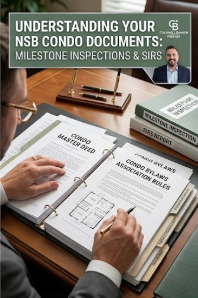
Buying a Condo in New Smyrna Beach: Five Documents That Tell You What You Are Really Buying
Ten years ago, buying a beachside condo here was a fairly simple transaction. You liked the view, the monthly fee looked reasonable, and you closed.
That is not the market anymore. After the Champlain Towers South collapse in 2021, Florida rewrote the rules for how older condo buildings get inspected and funded. The result is a market where two units in similar buildings, listed at similar prices, can carry wildly different future costs. One might be fully funded and current on inspections. The other might be eighteen months away from a six-figure special assessment.
The good news is that the difference is knowable. It is sitting in the association’s documents. Most buyers just never ask for them in time.
What changed in Florida condo law
Milestone inspections. Condo and cooperative buildings three or more habitable stories tall must undergo a structural safety inspection once the building reaches 30 years from its certificate of occupancy. Buildings within three miles of the coast can face an earlier timeline in some circumstances, which matters here, because a large share of our beachside inventory sits close to the water.
The inspection runs in phases. Phase 1 is a visual examination by a licensed architect or engineer covering the foundation, load-bearing walls, columns, floors and roof structure. If Phase 1 turns up substantial structural deterioration, Phase 2 is triggered, which involves more invasive testing. After the first inspection, re-inspection is required roughly every ten years.
Structural Integrity Reserve Studies. A SIRS is a specialized reserve study, also required for buildings three or more habitable stories, that evaluates the condition, remaining useful life and replacement cost of eight components: roof, load-bearing structure, fire protection, plumbing, electrical, waterproofing, windows and exterior doors, and other qualifying items affecting those systems. It has to be performed by a qualified professional, not estimated by the board, and updated at least every ten years.
Reserve waivers are gone for those components. This is the part that hits wallets. For decades, Florida boards routinely voted to waive or reduce reserve funding, which kept monthly dues artificially low and pushed the real cost into the future. That option no longer exists for the eight SIRS components. Associations are now required to fund them.
Put those three changes together and you get the wave of special assessments moving through Florida coastal condos right now. Some have been modest. Others have run from ten thousand to well over a hundred thousand dollars per unit.
The five documents to request
Ask for these the day your contract goes effective. Not on day nine of a ten-day inspection period.
1. The milestone inspection report. If the building is 30 years or older and three or more stories, this should exist. Ask for the full report, not the summary. Has Phase 1 been completed and submitted to the local building official? Was Phase 2 triggered, and what did it find? If repairs were required, what is the timeline and has funding been identified?
A Phase 2 finding is not automatically a reason to walk. Buildings get repaired. But a Phase 2 finding with no funding plan attached is a special assessment that has not been announced yet.
2. The Structural Integrity Reserve Study. Read the components table. It lists each structural item, its remaining useful life and its estimated replacement cost. Then compare that table to the association’s actual reserve balances. If the study says the roof has four years left and costs $1.8 million to replace, and the roof reserve holds $200,000, you now know something specific and important about your next several years of ownership.
3. Twelve months of board meeting minutes. Minutes are the most underused document in condo due diligence. They are where you find the conversation before the decision. Look for discussion of engineering reports, insurance renewal problems, contractor bids, litigation, and any mention of the word assessment. Boards talk about a big project for months before they vote on it.
4. The current budget, reserve balances and funding plan. Two numbers matter most. What are the reserves today, and what does the funding plan say they need to be?
Be careful with a low monthly fee. In this market, an unusually low fee on an older beachside building is frequently a symptom rather than a bargain. It often means the building has been underfunding for years and the correction is still coming. A higher fee on a building that has already completed its inspections, funded its reserves and finished its major projects can be the cheaper property over a ten-year hold. The sticker is not the cost.
5. Insurance declarations and special assessment history. Ask what the association pays for property and wind coverage, what the deductible is, and how the premium has moved over the last three renewals. Then ask for the assessment history. How many special assessments in the last five years, for what, and how much per unit? A pattern tells you how this board has historically handled deferred maintenance.
The financing angle most buyers miss
Conventional financing on a condo depends on the project, not just on you.
Fannie Mae and Freddie Mac maintain project eligibility standards, and buildings with significant deferred maintenance, unfunded structural repairs, insurance shortfalls or pending litigation can become ineligible for conventional loans. When that happens, the buyer pool for that building shrinks to cash and portfolio lenders, and values follow.
That matters twice. It affects whether you can get a loan today, and it affects who will be able to buy the unit from you later. Ask your lender to run the project review in week one.
How to think about all of this
I am not going to tell you to avoid condos in New Smyrna Beach. Some of the best properties in our market are condos, and a well-run building that has already done its inspections, funded its reserves and finished its concrete restoration is a genuinely attractive place to own.
What changed is that the quality of the association is now as important as the quality of the unit. The granite counters do not matter if the building has a $4 million waterproofing project and $300,000 in reserves.
Look at the documents first. Then look at the view.
Frequently asked questions
Does every condo in New Smyrna Beach need a milestone inspection?
No. The requirement applies to condominium and cooperative buildings three or more habitable stories tall, once the building reaches the age threshold. Low-rise buildings and townhome-style projects may fall outside it.
Can a milestone inspection replace the SIRS?
No. They are separate requirements. A milestone inspection assesses structural safety. A SIRS assesses funding for structural components. In certain situations the two can be coordinated on an overlapping timeline, but one does not substitute for the other.
Who pays a special assessment, the buyer or the seller?
It depends on when it was levied and what the contract says. An assessment already levied before closing is typically addressed in the contract. One that has been discussed but not yet voted on usually is not. This is exactly why the meeting minutes matter.
What is a reasonable reserve funding level?
There is no single number. The useful comparison is between what the reserve study says the components need and what the association actually holds, and whether the funding plan closes that gap on a defined schedule.
Are New Smyrna Beach condos a bad investment now?
Well-funded buildings that have completed their compliance work have gotten more attractive relative to buildings that have not, because the uncertainty has been removed. The spread between the two is where the risk sits.
Looking at a condo in New Smyrna Beach?
Before you spend money on an inspection, send me the building. I will request the milestone report, the reserve study and the recent minutes, and go through them with you so you know what you are buying into.
Ryan Tesnow, MPA, REALTOR®, Broker Associate
Coldwell Banker Premier
Cell: 254.206.5020
RyanTesnow@PremierMove.com
RealEstate-WithRyan.com
General information, not legal, engineering or financial advice. Requirements under Florida Statutes Chapter 718 and Section 553.899 have been amended several times. Confirm current requirements with a Florida community association attorney or licensed engineer for any specific building.